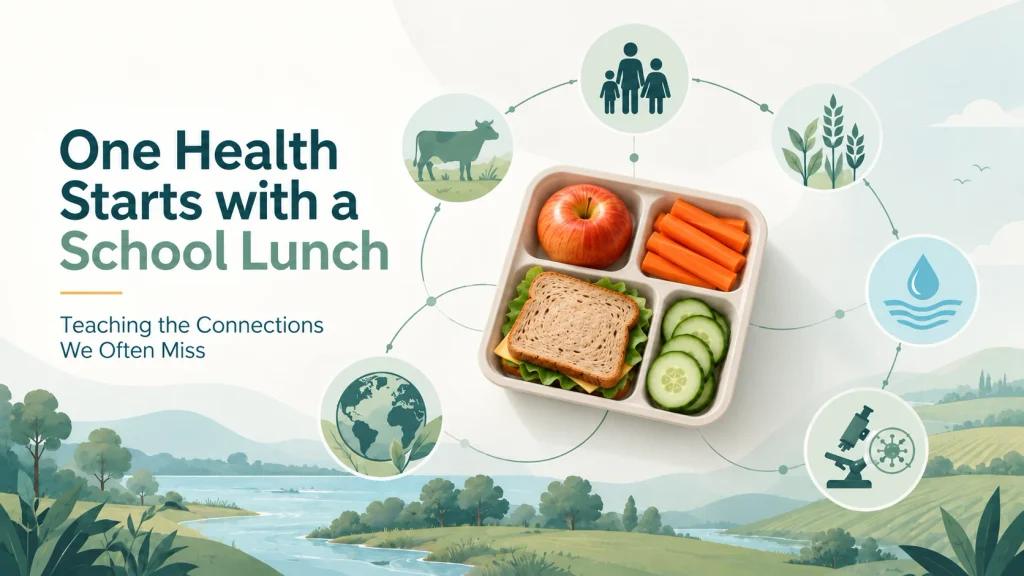
One Health Starts with a School Lunch: Teaching the Connections We Often Miss
Imagine a student opening a lunchbox: bread, cheese, an apple and a bottle of water. Nothing unusual. Now imagine a teacher asking a question that changes how the class sees that meal: What had to happen for this food to get here?
In a nutshell, someone grew grain for the bread. Someone cared for the animals. Water helped the crops grow. The food was collected, prepared, transported and stored. By the time it reaches the lunchbox, the story has crossed farms, ecosystems, workplaces and kitchens.
A school lunch cannot explain the whole world. But it can offer a surprisingly good starting point on how our health is connected to the world around us.
What does lunch have to do with One Health?
The World Health Organization (WHO) describes One Health as “an integrated, unifying approach” that considers the health of people, animals, plants and ecosystems together. It recognises that problems do not always arrive neatly labelled as human health, animal health or environmental health, and that addressing them may require several kinds of expertise.
Food makes those connections tangible. Consider the apple. Its journey starts long before the shop or school canteen: growing conditions, water, soil and plant health all matter. Consider the cheese. Animal health is part of its production, but so are hygienic processing, transport and storage. And the water in the bottle invites questions about access to safe drinking water and the systems that provide it.
The Food and Agriculture Organization of the United Nations (FAO) identifies food safety as a One Health issue because what we eat brings human, animal, plant and environmental systems into direct contact. It does not mean that the lunch in front of us is unsafe. It means that keeping food safe depends on more than one point along its journey.
A familiar example is food handling. WHO’s Five Keys to Safer Food stress hygiene, preventing contact between raw and cooked foods, adequate cooking, appropriate storage temperatures and safe water and ingredients. These are practical safeguards, not abstract scientific ideas. They also help students see why a health question may begin on a farm and continue in a kitchen.
The connections continue after the meal
What happens to food that is thrown away? Growing, processing, transporting and storing it required resources, whether or not it was eaten. FAO explains that food loss and waste place avoidable pressure on land, water and energy and have wider environmental consequences.
But it would be misleading to turn this into a quick lesson about which lunch is “good” or “bad”. Food choices also involve affordability, availability, dietary needs, culture and local circumstances. One Health invites us to notice these competing considerations rather than pretend that every question has one simple answer.
That makes lunch a useful starting point for a classroom conversation, not because children are expected to solve food-system problems, but because they can learn to recognise a question that needs more than one perspective.
A classroom activity: follow one ingredient
An educator could begin with a fictional lunch menu or a picture of a meal. There is no need for pupils to disclose what they eat at home, or to compare one another’s lunches.
Choose one item—perhaps an apple—and place it in the centre of a sheet of paper. Ask the class to work backwards: What was needed to grow it? Where might water, soil, transport and food handling enter the picture? Draw arrows between the elements but give each arrow a label: something we know, something we could check, or a question we still have.
Next, change the point of view. What might a farmer want to know? A public-health professional? An environmental scientist? A family choosing food within a budget? Students need not provide expert answers. The exercise is to discover why people with different knowledge—and different constraints—may ask different questions about the same thing.
Finally, give the class a modest decision to consider: How might a school reduce food waste without compromising food safety or students’ needs? Invite possible solutions, then ask what evidence would help judge them. A simple paper diagram and a conversation are sufficient; a digital tool is optional.
This is a proposed teaching example, not a tested BEACON lesson. Its value lies in the questions it makes possible. A line drawn between two ideas does not, by itself, prove that one causes the other. Sometimes the most useful thing a learner can say is, “We need to find out.”
Learning to see the bigger picture
A One Health discussion can begin in science, but it does not have to stay there. It may lead to geography, food production, civic decisions or the interpretation of evidence. UNESCO’s recent guidance on education for sustainable development emphasises critical thinking, collaboration and finding ways to assess what learners understand. Those are useful considerations when designing an activity like this; the activity itself has not been evaluated.
A good conclusion to the lunchbox exercise is therefore not a perfect diagram. It is a better set of questions: Which relationships can we explain? What is missing? Who might help us answer? And how would we recognise trustworthy evidence?
Where BEACON comes in
BEACON (COST Action CA24106) brings researchers and educators together around One Health education. Its five Working Groups address curriculum development, educator training, student engagement, evaluation and legal and ethical considerations. Their work reflects a central challenge of One Health education: making connected scientific ideas meaningful, teachable and responsible.
The lunchbox example illustrates that ambition; it is not an announcement of a BEACON classroom pilot, approved teaching resource or demonstrated outcome.
For a teacher considering where to start, the first step need not be elaborate. Begin with something familiar, follow one connection, and leave room for the questions that follow. Lunch will not give students every answer. It may however help them ask better ones.
Sources and further reading